 En
/ €
En
/ €
 Français

The mystery of Triops mongolia: valid species or simple synonym of Triops granarius?

Triops mongolia is a species presumed endemic to the semi-arid steppes of Mongolia
Triops Mongolia (often spelled Triops Mongolei in German-speaking contexts) is a designation commonly used in trade and aquariums for a specific variant of branchiopod crustacean in the family Triopsidae, native to Central Asia.
Indeed, Triops mongolia is a presumed endemic species of the semi-arid steppes of Mongolia, remarkably adapted to the extreme conditions of this Central Asian country. However, the available scientific information is limited, as this taxon has not been the subject of detailed official descriptions in the taxonomic literature and is often only mentioned in commercial contexts or in ecological studies dealing with branchiopod communities.
This article aims to explore this issue and attempt to clarify the true taxonomic name that should be assigned to this Triops of the Mongolian steppes.
The special case of Triops mongolia
The diversity of large branchiopods in the temporary ponds of Mongolia
Mongolia is known to harbor a very homogeneous diversity of large branchiopods in its ponds and temporary water bodies, despite highly fluctuating and sometimes harsh climatic conditions. These communities generally include species such as Triops numidicus, Branchipodopsis affinis, Eocyzicus davidi, and Lynceus dauricus, all adapted to a fast-paced life in ephemeral ponds that fill up during the rainy season and then dry up in a few months. There is no official record of a "Triops mongolia" distinct from these species in the validated scientific literature to date – therefore, it is either a trade synonym for a local form or a provisional designation pending taxonomic revision.
Genetics: The Unresolved Case of Triops mongolia
From a taxonomic point of view, the name Triops mongolia is not officially recognized in current classifications (notably those of Longhurst in 1955 and the ICZN in 1958). Scientific sources generally classify this population with Triops granarius or, in older references, with the synonym Triops dybowskii (Kingsley, 1881). Although recent genetic analyses confirm a close relationship between the Triops of Central Asia (Mongolia, Japan, Northern China), further molecular studies are needed to determine whether Triops mongolia is indeed a separate species or simply a distinct genetic lineage from Triops granarius.
Re-evaluation of the Central Asian Triops Group
As we have just seen, the classification of Triops species found in this vast geographical region remains complex. In light of recent scientific revisions (particularly those conducted by Hidetoshi Naganawa), it has become necessary to clarify the situation. The objective is to determine whether Triops mongolia represents a distinct species or is simply a local form of Triops granarius.
Although these populations share a clear relationship, the taxonomic status of the Triops species originating from Central Asia remains ambiguous. Further genetic and morphological analyses are essential to definitively establish whether it constitutes a separate species or a regional variant of Triops granarius.
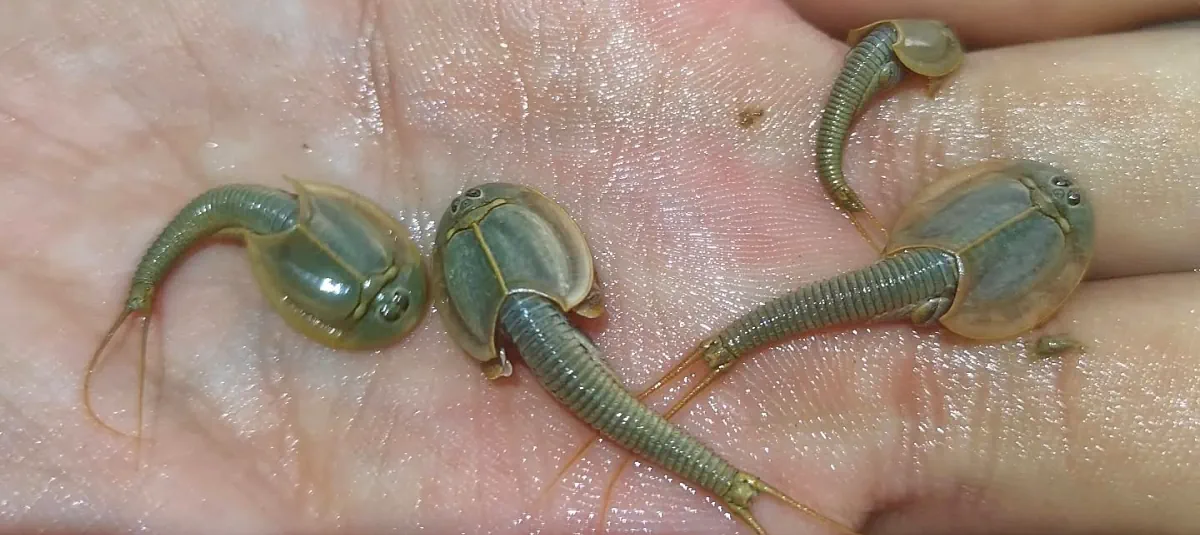
The characteristics of Triops mongolia (particularly its "long tail") suggest, according to research by Hidetoshi Naganawa (2020), that it should be classified as Triops dybowskii.
Taxonomic Clarification: The Challenge of Distinguishing Central Asian Triops
The group of crustaceans designated by Triops granarius (in the broad sense) – which extends from Africa to Asia – has long been a source of taxonomic confusion. Recent work (including that of Naganawa, 2018) confirms that the name Triops sinensis is actually a synonym for the true Triops granarius (in the strict sense, described by Lucas in 1864).
However, it is crucial to note that the true Triops granarius of Asia (around Beijing and in Japan) is clearly distinct, both morphologically and genetically, from the species commonly called "Triops granarius" in the region extending from Africa to the Middle East. To resolve this confusion, it is therefore necessary to give this latter population a distinct name.
Our answer to this question is based on the work of Hidetoshi Naganawa (2020), who proposes reviving the name Triops dybowskii (Braem, 1893) to designate this widely distributed group.
This distinction is confirmed by the analysis of Lucas's original description (1864). Drawings of the type specimen show that the Beijing species has a "short tail" (with 8 to 10 apodal segments). This contradicts the original description and suggests that the species described by Lucas was not the "long-tailed" one (12 to 14 segments) which is the most common in Eurasia.
Consequently, the main objective of this study is to clarify the complex taxonomy of the group by clearly defining two entities:
- Triops granarius (s.str.): The East Asian ("short-tailed") species.
- Triops dybowskii: The species widely distributed in Africa and the Middle East.
Furthermore, this clarification allows us to distinguish, for the first time, Triops numidicus (another often confused species) from these two taxa.
Triops granarius (Lucas, 1864): Corrected Taxonomic Status
Based on research by Hidetoshi Naganawa published in 2020, this section establishes a strict taxonomic definition of Triops granarius, restricting this name to East Asian populations to resolve a long-standing confusion.
Taxonomic Status and Synonyms
The name Triops granarius (Lucas, 1864) has been misapplied to various species by numerous authors over the decades. We propose here to restrict it to the designation Triops granarius sensu stricto (s.str.), corresponding to the East Asian populations.
Many previously used names are now considered synonyms (Syn.) of T. granarius s.str., including: Apus sudanicus var. Apus numidicus var. sinensis Braem, 1893, Apus numidicus var. sinensis Uéno, 1925, and Triops sinensis.
Note: The synonym Apus sudanicus var. chinensis is particularly reliable, but the eight original type specimens were unfortunately lost during the Battle of Wrocław in 1945.
Geographic Distribution
The species *Triops granarius* s.str. is restricted to the East Asian region, specifically northeastern China and western Japan.
In summary, the new phylogenetic analysis of the Triops granarius group (in the broad sense) has confirmed the presence of eight distinct species within the genus *Triops*. The results of this classification, supported by 1000 bootstrap replicates, are illustrated in this figure:

Taxonomic conclusion
The proposed taxonomic revision, based in particular on the Naganawa phylogenetic tree (2018), aims to clarify the confusion surrounding the Triops granarius (s.l.) group. It identifies eight distinct species within the genus Triops, where T. granarius s.str. is now strictly defined as the East Asian "short-tailed" population.
Results of Phylogenetic Analysis (MJN Network)
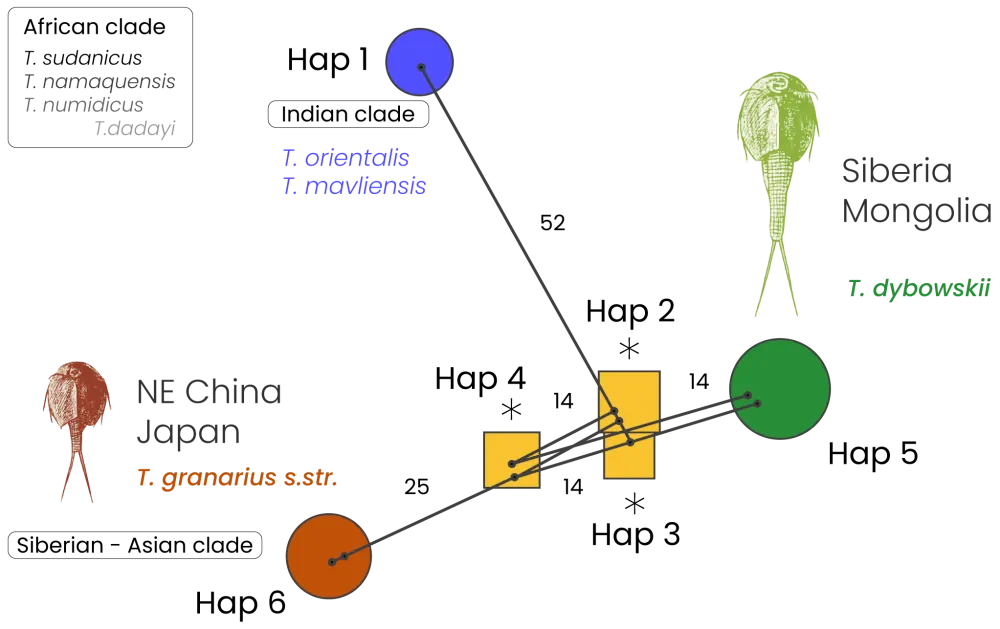
Median JN network analysis identified six distinct haplotypes among Triops populations in Asia (Figure 3). Three of these haplotypes represent specific geographic groups:
- Sibero-Asian Haplotype (Hap 5): This includes Triops populations sampled in the Ural and Irkutsk regions (Russia), as well as in Mongolia and Inner Mongolia (China).
- East Asian Haplotype (Hap 6): This is specific to populations from northeastern China (Manchuria) and Japan.
- Indian Haplotype (Hap 1): This characterizes populations originating from India.
The six haplotypes are linked within the network by three missing intermediate haplotypes (Hap 2*, Hap 3*, and Hap 4*) – represented by asterisks – which probably correspond to extinct lineages.
The study of mutation distances between these haplotypes reveals the divergence patterns:
- The Indian haplotype (Hap 1) is separated from Hap 2* by 52 mutations.
- The East Asian haplotype (Hap 6) is separated from Hap 4* by 25 mutations.
- The Siberian Asian haplotype (Hap 5) is much closer, being separated from Hap 3* by only 13 mutations.
- The intermediate haplotypes themselves are separated by 14 mutations.
In conclusion, the presence of long branches in the network of connections indicates that the genetic lineages corresponding to the Indian (Hap 1) and East Asian (Hap 6) haplotypes diverged from other Asian populations much earlier in history.
- evolution of the group.
Haplotype network graph
Below is a haplotype network graph, illustrating the supposed regional evolution of Asian Triops, which was created using Network software version 10.0.0.0. Each mutation not shown in this figure is completed as follows: the missing intermediate haplotype (represented by an asterisk; corresponding to an extinct or unknown population), Hap 3, is separated from Hap 2 by 14 mutations. Furthermore, within the haplotypes Hap 2, Hap 3, Hap 4, Hap 5, and Hap 6, a mutation is observed for each.
 Buy a kit of 50 Triops mongolia eggs