 En
/ €
En
/ €
 Français

Branchinella thailandensis is a small freshwater anostracan belonging to the Branchiopoda order, closely related to brine shrimp but strictly found in freshwater.
Like most Anostraca, it produces resistance cysts (dormant eggs) at the end of its life cycle, an essential adaptation for surviving the seasonal desiccation of its ephemeral habitats. These cysts, formed after sexual reproduction, are protected by a highly resistant chitinous shell and enter embryonic diapause. They can remain viable for several months to several years in dry conditions before resuming their development upon rehydration.
Initially, the eggs of Branchinella thailandensis form in an egg sac in the female, sink to the bottom, and are then harvested and dried before being packaged.
In captivity, breeding is relatively simple and can be carried out in small tanks, provided that stable physicochemical parameters and very controlled feeding are maintained.
Here is the step-by-step life cycle:
1. Cyst Formation Stages
Branchinella thailandensis reproduces exclusively sexually. The male grasps the female with his modified antennae, fertilizes her, and then releases her. The fertilized eggs are stored in an ovigerous chamber (ovigerous sac), visible as an elongated, translucent capsule on the female's abdomen. Within 24 to 48 hours, the eggs develop a thick shell and turn beige to light brown: they have then become resistant cysts. The female then expels the cysts, which sink to the bottom of the substrate.
These cysts then enter a dormant state (diapause) and can survive desiccation, cold, or high temperatures.
Cysts produced at the beginning of the reproductive phase (first eggs laid by young females) generally have a better hatching rate (up to approximately 99%) and greater viability than those laid at the end of their lives, when the adults are old and weakened (studies on Branchinella thailandensis and related anostracans, see Plodsomboon et al., 2012).
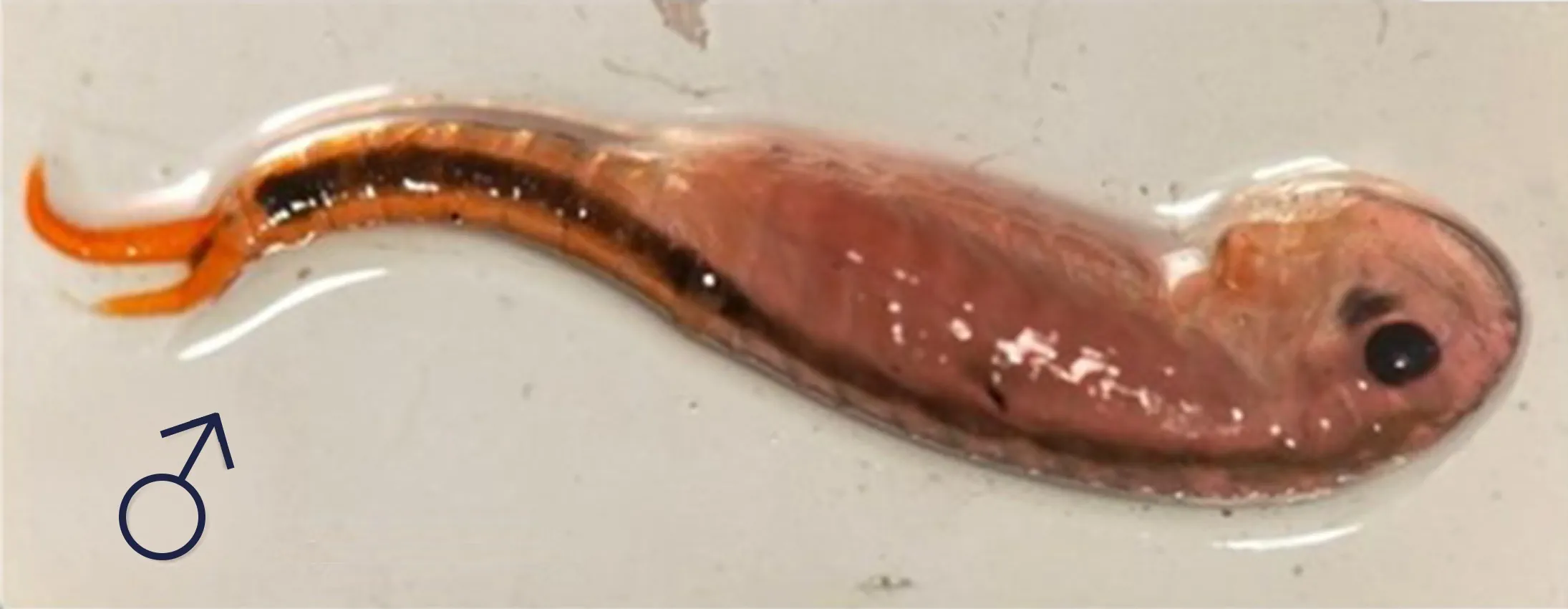
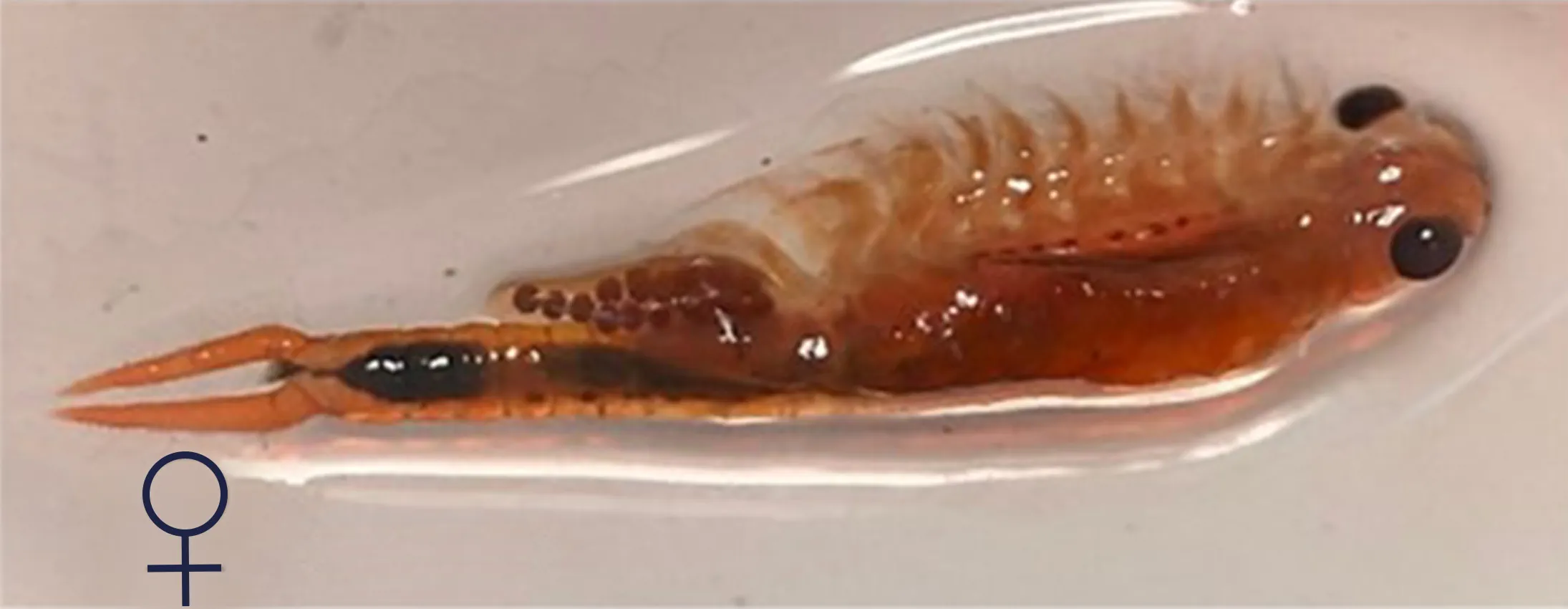
Branchinella thailandensis eggs are formed in an egg sac in the female
2. Conditions Favorable to Abundant and High-Quality Production
Recommended Equipment and Volumes
For hatching cysts, a 300 to 500 mL container is sufficient. However, as the individuals grow, a gradual transfer to larger containers is essential to avoid overcrowding:
- 3 to 5 L for the early growth stages
- 10 to 15 L for a dense adult population
Before use, it is recommended to clean and disinfect the containers (diluted bleach solution), then rinse them thoroughly and allow them to dry completely to eliminate any toxic residue.
For small volumes, maintaining the temperature can be facilitated by a water bath system, which offers better thermal stability than a conventional aquarium heater.
Water Quality and Parameters
Water is a determining factor for successful hatching and development.
Water Quality
Very low mineral content water (conductivity < 200 µS/cm), pH close to neutral (6.8–7.5), free of heavy metals and pollutants. Good oxygenation and the absence of ammonia/nitrites are essential. Reverse osmosis water or rainwater are preferred.
Temperature
24–28 °C is the optimal range for rapid growth and reproduction. At this temperature, sexual maturity is reached in 2 to 3 weeks and adult lifespan is 6 to 8 weeks (Sanoamuang, 2002; observations from controlled rearing). A stable temperature within this range promotes both growth and reproduction.
Other Key Factors
Abundant but Not Excessive Feeding
Ad libitum feeding with microalgae (Chlorella, Dunaliella, Scenedesmus, Spirulina), nutritional yeasts, or fine invertebrate foods increases the fecundity and quality of cysts (studies on Anostraca, Brendonck, 1996; generalized to B. thailandensis).
The secret to proper feeding lies in observation: correct distribution temporarily clouds the water while the organisms filter it. Water that remains cloudy for more than two days indicates that the amount of food exceeds the tank's absorption capacity, thus risking pollution.
Retention period in the parental environment
Cysts must remain in the rearing tank for 2 to 4 weeks after spawning to complete embryogenesis and achieve maximum viability (Rogers et al., 2013; Anostraca rearing protocols).
Moderate Stress at the End of the Cycle
A slight reduction in food or a drop in temperature (< 22°C) at the end of life accelerates the formation of the last batches of good-quality cysts.
3. Practical Harvesting and Packaging Protocol
Cyst Hatching and Harvesting Process
- Maintain a breeding tank for adult fish at 24–28 °C with abundant feeding for 4 to 6 weeks after the first spawning.
- Allow the cysts to accumulate at the bottom (a sandy substrate is recommended).
- Let the tank cycle for 3 to 4 weeks after the start of spawning to allow the cysts time to complete their embryonic development.
- Once sufficient production is achieved, remove the adults or allow the tank to empty naturally (natural mortality).
- Allow the water to evaporate slowly until the substrate is completely dry (several days to weeks depending on the volume).
- Gently scrape the dry substrate from the bottom with a spatula or card to collect the "sand + cysts" mixture.
- Sift if necessary to remove large particles debris.
Drying and storage of cysts
- Dry completely in the open air, in the shade and in a well-ventilated area (48–72 h). The cysts must be perfectly dry: excessive residual moisture restarts metabolism and reduces long-term viability.
- Store in airtight, opaque containers, protected from light and moisture, at a cool and stable temperature (e.g., a few degrees above 0°C to moderate room temperature), avoiding repeated hot/cold cycles. Some protocols recommend storage in a reduced atmosphere (e.g., vacuum packing or with minimal air) to limit oxidation.
Under these conditions, B. thailandensis cysts retain excellent viability for several months to several years (similar to Artemia and other Anostraca species, Brendonck, 1996; FAO, 2010). To reactivate them: rehydrate at 24–28 °C in clean, fresh water with gentle aeration and 12–14 hours of light per day. Hatching usually occurs within 24–72 hours for well-formed cysts.
4. Cyst Hydration and Hatching
Vitable cysts hydrate rapidly and sink to the bottom of the container, indicating they are ready to hatch. Hatching typically occurs between 8 hours and 3 days, most often within 24 to 48 hours at 22–25 °C.
Newly hatched nauplii resemble those of Artemia salina, except for their coloration, which is usually translucent. They exhibit positive phototropism, being attracted to light.
Unlike Artemia, aeration or water movement is not necessary to trigger hatching. No feeding is recommended during the first 48 hours, as the nauplii use their internal reserves.
5. Feeding and feeding strategy
Type of feeding
Branchinella are non-selective filter feeders, feeding on microscopic suspended particles:
- microalgae
- bacteria
- spores
- fine organic debris
Suitable food sources include:
- live phytoplankton (ideal)
- very finely powdered spirulina or chlorella
- commercial rotifer foods
- homemade mixes (spirulina + finely ground fish flakes, decanted to retain only the finest particles)
Feeding Frequency and Control
Feeding should be extremely moderate. The water should become slightly cloudy after feeding, but clear again within 24 to 48 hours. Persistently cloudy water indicates overfeeding, which is often responsible for failures (bacterial proliferation, oxygen depletion).
In Practice:
- Feed approximately every 2 days
- Refeed only when the water has become clear again
Maintenance, Growth, and Development
Water Changes
Water changes are inevitable, but must be carried out with great care. Branchinella are very sensitive to sudden changes in temperature, pH, and conductivity.
The new water must have:
- the same physicochemical parameters
- the same temperature as the tank
Partial water changes are preferable.
Growth Stages and Sexual Dimorphism
After hatching, growth is rapid:
- 24–48 h: hatching of nauplii
- ≈ 2 weeks: adult morphology reached (8–10 mm)
- ≈ 3 weeks: sexual maturity
Males generally grow faster than females. At maturity, females measure approximately 25 mm and develop whitish egg sacs visible on the ventral side of the abdomen.