 En
/ €
 Français

Lynceus brachyurus—known in English as a "clam shrimp" and in German as a "Muschelschaler"—is a tiny freshwater crustacean belonging to the group Branchiopoda. It has a highly distinctive appearance: its body is protected by a bivalve-like shell, reminiscent of a small mollusk, even though it is, in fact, a crustacean equipped with numerous thoracic legs.
As an inconspicuous inhabitant of temporary ponds, this microcrustacean follows a life cycle closely tied to the seasonal fluctuations of its environment. Its development, feeding habits, and reproductive strategies make it a fascinating subject for those with an interest in aquatic biology and the keeping of small invertebrates.
Profile
| Characteristic | Description |
|---|---|
| Scientific name | Lynceus brachyurus |
| Taxonomic authority | Müller, 1776 |
| Kingdom | Animalia |
| Phylum | Arthropoda |
| Subphylum | Crustacea |
| Class | Branchiopoda |
| Order | Laevicaudata |
| Family | Lynceidae |
| Habitat | Temporary ponds, floodable depressions, and vernal pools |
| Diet | Detritus, suspended particles, and small zooplankton |
| Reproduction | Sexual, with observed mating |
| Distinguishing feature | Globular carapace with no visible growth lines |
| Adult size | 3 to 4 mm |
| Natural environment | Freshwater |
| Lifestyle | Primarily benthic |
Morphology: a crustacean that resembles a shell
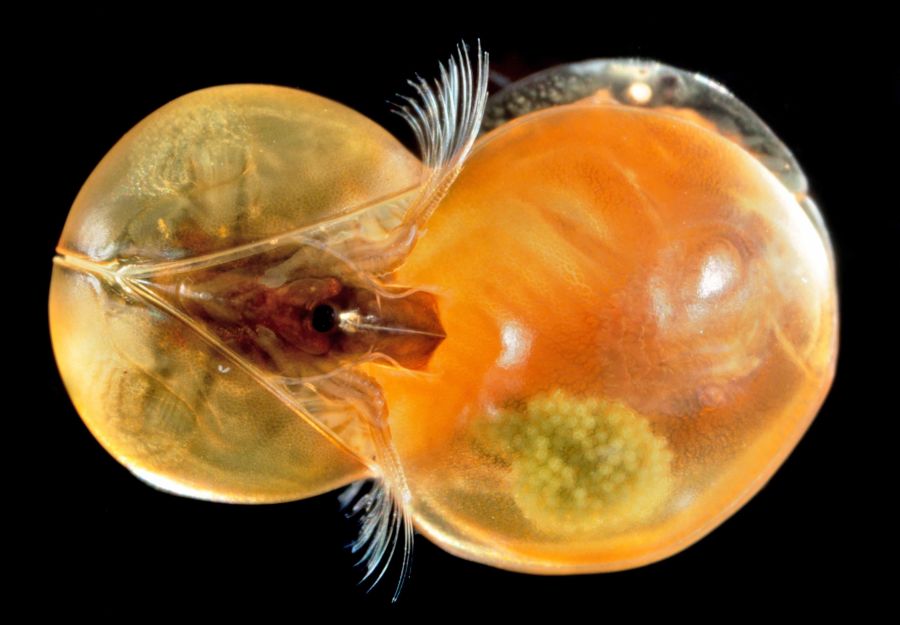
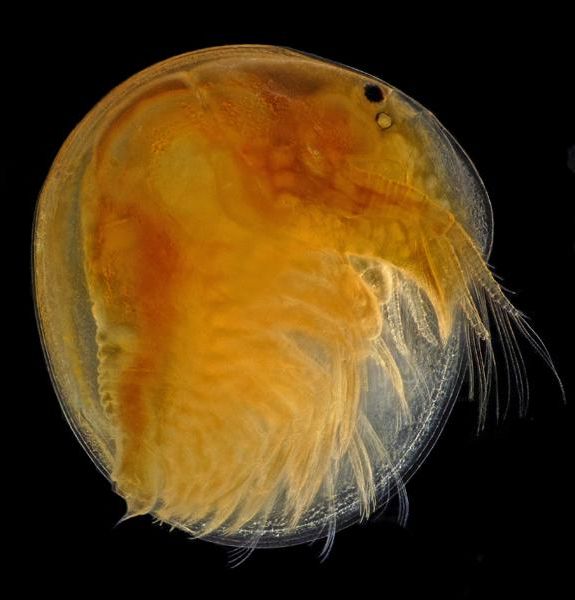
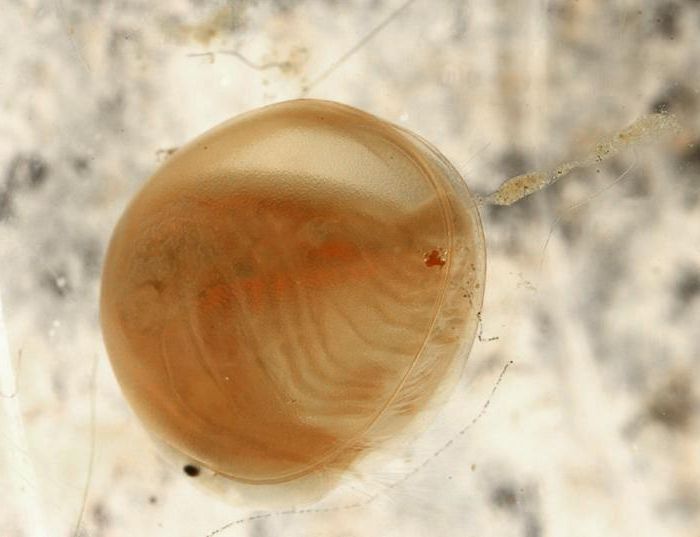
The body of Lynceus brachyurus is almost entirely enclosed within a carapace consisting of two valves—a right and a left—which gives it the appearance of a tiny lens or a small bivalve. Unlike that of some other "clam shrimp" species, its carapace is globular and lacks clearly visible growth lines.
This resemblance to a mollusk should not be misleading: it is, in fact, an arthropod, equipped with jointed appendages and a body organized into segments.
Coloration and sexual dimorphism
- Young individuals: generally yellowish or translucent.
- Adults: coloration may shift toward green or dark brown.
- Females: often larger, with clusters of greenish eggs visible through the carapace.
- Males: generally smaller and lighter in color, with a shorter, truncated tip on the rostrum.
The shape of the rostrum—an extension of the anterior region of the head—is one of the characteristics used to distinguish between the sexes. These morphological details have been documented in specimens observed in France.
Natural Habitat and Geographic Distribution
Lynceus brachyurus is a species found in various temperate and cold regions of the Northern Hemisphere. Its documented distribution includes parts of Europe, Asia, and North America.
It primarily inhabits temporary ponds and flood-prone depressions, where water may persist for several weeks or months before drying up. Some of these habitats are replenished by precipitation or groundwater seepage rather than by permanent watercourses.
These environments share a key characteristic: they undergo significant seasonal fluctuations and are often devoid of fish. The ephemeral nature of the water limits the presence of many aquatic predators, thereby fostering specialized crustacean communities.
Lynceus brachyurus is particularly associated with vernal (spring) ponds that fill during the cold season and gradually dry out as spring or summer progresses. Consequently, it should not be viewed as a crustacean typical of permanent tropical aquarium environments.
Locomotion and Behavior
Despite its small size and relatively bulky carapace, Lynceus brachyurus is capable of active swimming. Nevertheless, its lifestyle remains primarily benthic—that is, associated with the bottom of its aquatic environment.
Observations indicate an alternation between periods of swimming, resting, and mating. The animal may settle on the substrate or cling to submerged plant debris, at which point its movements become slower.
This alternation between movement and rest aligns with its feeding behavior: the crustacean exploits resources available on the bottom while also capturing particles suspended in the water.
Feeding Habits
Lynceus brachyurus is a highly active filter feeder: its thoracic appendages, which are in constant motion, generate a water current that draws in suspended organic particles, upon which it feeds.
Research on this species indicates that its diet is more diverse than the simple filtration of phytoplankton.
It includes, in particular:
- suspended organic detritus particles;
- organic matter collected by scraping the substrate;
- small zooplanktonic organisms;
- various food particles available within its habitat.
Observations of digestive tract contents and experiments reported by Patton (2014) confirm this mixed diet.
What to feed them in captivity?
For cultivation in captivity, the most appropriate food sources include:
- a fine suspension of microalgae—for example, based on spirulina or chlorella;
- very fine organic particles;
- a well-monitored natural biofilm;
- small planktonic prey, provided they are of an appropriate size.
Reproduction and resting eggs
The reproduction of Lynceus brachyurus has been the subject of detailed observation. Males and females mate, and a female can produce multiple batches of eggs over the course of her lifetime.
Patton (2014) reports that ovulation occurs following stimulation by a male, and that a female can produce new batches of eggs without an intervening molt. Multiple matings are required to produce the large egg masses observed in some females.
Can the eggs remain dormant for several years?
Large branchiopods inhabiting temporary environments typically produce resting eggs capable of surviving unfavorable periods. These eggs can persist in the sediment, forming an "egg bank" that allows the population to reappear once conditions become favorable again.
How do the eggs hatch?
Field observations in France indicate that this species follows a winter or spring life cycle. In populations studied in the Aube department, hatching has been recorded approximately twelve days after the habitat is refilled with water—sometimes as early as January. The first adults reach maturity toward the end of April or in May.
Life Cycle and Development Duration
The development of Lynceus brachyurus involves several larval stages, followed by a juvenile phase, before reaching the adult stage. The eggs hatch into nauplii, which progress through four larval stages as described in the scientific literature; the metamorphosis into the first juvenile stage represents a significant morphological transition.
Newly hatched larvae are very small, yet they possess a large, characteristic dorsal shield that makes them easy to identify in plankton samples.
Field observations indicate a relatively long seasonal development period for a large branchiopod. In the populations studied, the first larvae appear in late winter or early spring, while the first egg-bearing (ovigerous) females are observed in late April or May. In France, one study reports a duration of approximately 90 days from the first larval stage to maturity.
These timeframes do not constitute a fixed schedule applicable to a home-rearing environment; factors such as temperature, photoperiod, water quality, and the storage conditions of the resting eggs (cysts) can all influence hatching, growth, and maturation.
Compatibility with Aquariums and Other Animals
Due to their tiny adult size, Lynceus brachyurus are vulnerable to predation. Literature on large branchiopods indicates that these animals are typically found in habitats where fish are either absent or present only in low numbers.
Therefore, a dedicated tank—free of fish—is the best choice for keeping them.
Coexistence with Triops or other invertebrates should not be assumed to be risk-free: predation, competition for food, and differences in environmental requirements can all jeopardize the culture.
This crustacean is best suited for a small-scale observational setup—focused on microcrustaceans and organisms typical of temporary water bodies—rather than as an inhabitant for a standard community aquarium.
Frequently Asked Questions
What is the size of Lynceus brachyurus?
Adults typically measure around 3 to 4 mm, according to a study by Durr and Thiery (2020). It is, therefore, a much smaller animal than most adult Triops.
Can it be raised in a standard aquarium?
A small container dedicated to observation is preferable. This species is associated with temporary bodies of water and specific seasonal dynamics; the parameters suitable for a permanent tropical aquarium are not necessarily appropriate.
How long does it take to reach the adult stage?
In populations studied in France, the life cycle spans from hatching in winter to reaching maturity in the spring, with a growth period of approximately 90 days. Rearing conditions may alter this timeline.
Can the eggs remain viable for several years?
Dormant (resting) eggs are a key adaptation of large branchiopods to temporary environments. However, without data specific to a given batch, it is not possible to guarantee a shelf life or a specific hatching rate.
What does it eat?
Its diet consists of detritus, organic particles, and small zooplankton.
Microalgae and fine food particles represent plausible options for rearing, though they should be tested with caution.